Nine Squares and a Wandering Mind
I have been trying to understand how neural networks work. My friend Alex sent me a document explaining the basics, beginning with a remarkably simple illustration: nine squares arranged in a three-by-three grid.
Some of the squares are black, others white. In one arrangement, they form an X. In another, a plus sign. The black squares are represented by ones, the white squares by zeros.
That's about as simple as you can get.
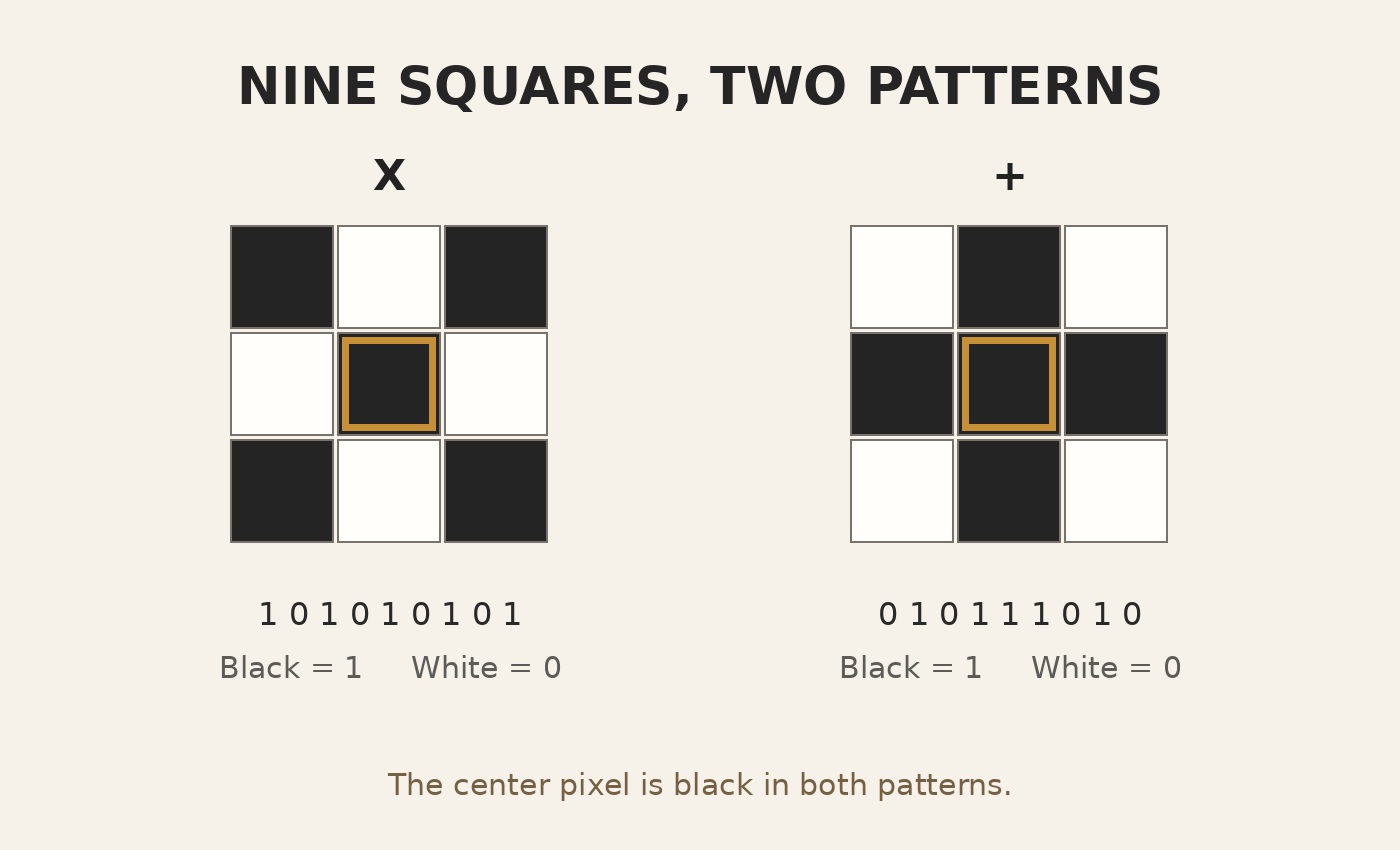
Nine Squares, Two Patterns: Both symbols share a black center square, but differ in the surrounding squares.
We haven't gotten much farther than that first illustration, because I keep getting distracted.
The nine squares reminded me of eight-bit computing. Why nine? Why not eight? That led to a discussion of binary numbers, bytes, and the difference between storing information and arranging it into something recognizable.
Then I noticed that both the X and the plus sign share the same black center square. That turns out to be important. If you're trying to distinguish one symbol from the other, the center square tells you nothing. It's the surrounding squares that matter.
And that led us toward the idea of weights in neural networks: some inputs are more useful than others for making a particular distinction.
But before we could get to weights, I remembered cellular automata.
Years ago, I became fascinated by those simple grids in which individual cells follow a handful of rules, producing patterns of astonishing complexity. More recently, I encountered them again through Stephen Wolfram. His work led me back toward complexity theory, emergence, and the extraordinary things that can happen when simple operations are repeated.
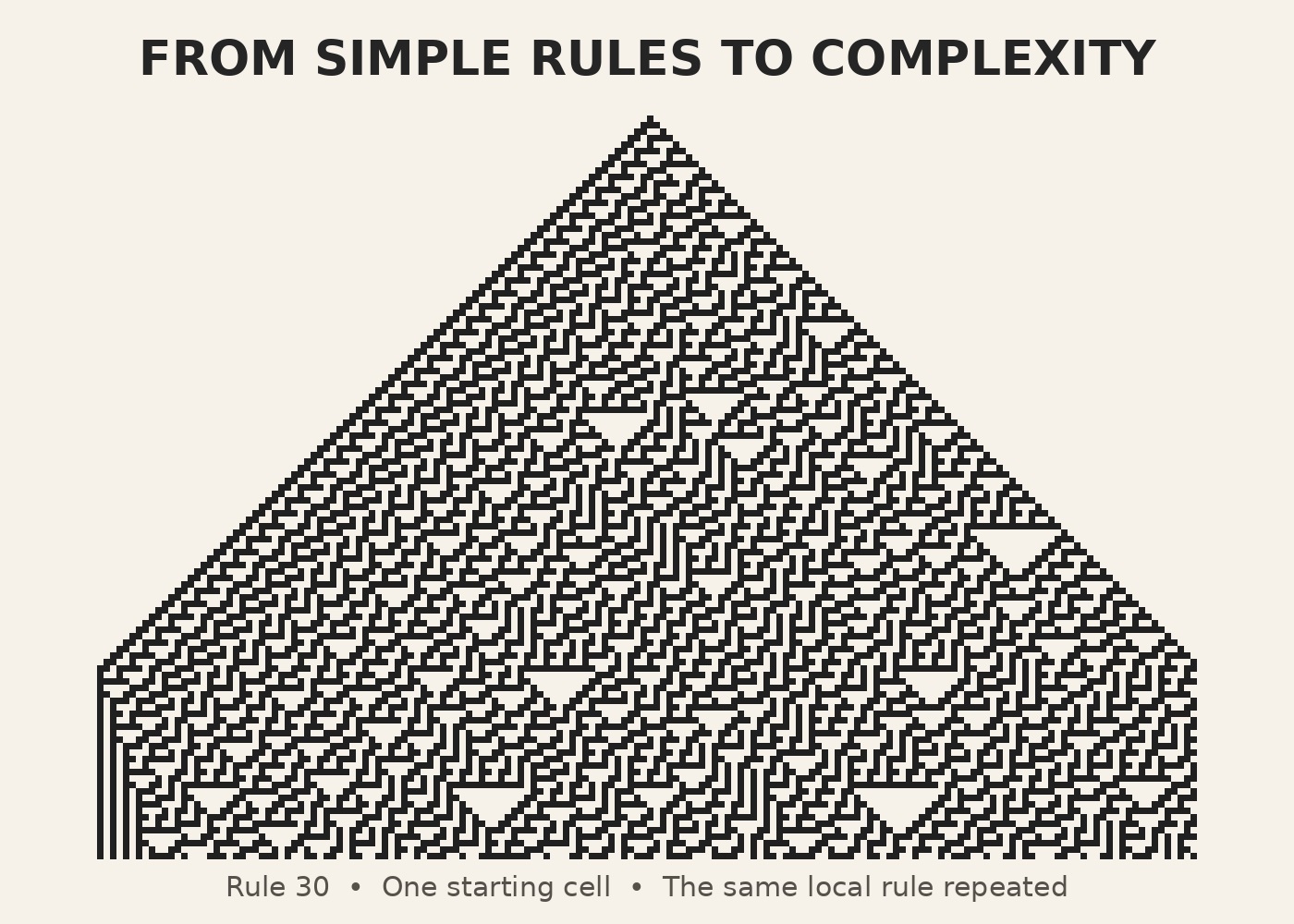
Rule 30: Each square looks at three squares directly above it: left, center, and right. It becomes black when only the left square is black, only the center square is black, only the right square is black, or when the left square is white and the other two are black. In every other case, it becomes white. Starting with a single black square, repeating this rule produces the astonishing complexity you see here.
Then came Mandelbrot and fractals, and M. C. Escher, whose work I've admired for years.
And that reminded me of an afternoon in Jim's garden.
A few months ago, at Jim's encouragement, I tried mushrooms. It wasn't an especially pleasant experience overall, and I've already written about it. But one part of that afternoon was extraordinary. Sitting in his garden, I watched the grass become a moving field of intricate colors and repeating patterns. It was as though the ordinary world had briefly become an animated fractal.
I have no reason to believe that the grass was doing anything unusual. Something had changed in my perception of it.
And that brought me right back to the neural network.
What does it mean to recognize a pattern? What does it mean to generate one? And what does it mean to perceive one?
These are different questions. They belong to different fields of study. But placing them next to one another changes how I think about each of them.
I am not trying to prove that they are all manifestations of some grand underlying principle. I'm not looking for a theory of everything, and certainly not a religious explanation.
I'm interested in what happens when ideas that ordinarily live in separate compartments are allowed to encounter one another.
This is something I've done throughout my life as an artist. Bring two things together that don't seem to belong together. Look at them. Let them interfere with one another. See whether something unexpected appears.
Sometimes nothing happens. Sometimes the connection is superficial. Sometimes the whole exercise turns out to be nonsense.
But every once in a while, a new pathway opens.
Perhaps that's what interests me most about studying artificial intelligence. Not simply learning how a neural network works, although I certainly want to understand that, but discovering how the attempt to understand it changes the questions I ask about other things.
Alex sent me seven pages explaining neural networks.
So far, we've barely finished the first illustration.
And I don't feel we're behind at all.
We're exactly where we want to be, living inside the question, wandering through its landscape and wondering what lies beyond the next turn.
All this wandering also made me wonder what Mary Shelley might think of it. Since Molly and I have already been corresponding with her through the Mary Shelley Letters, we decided to invite her into this conversation.
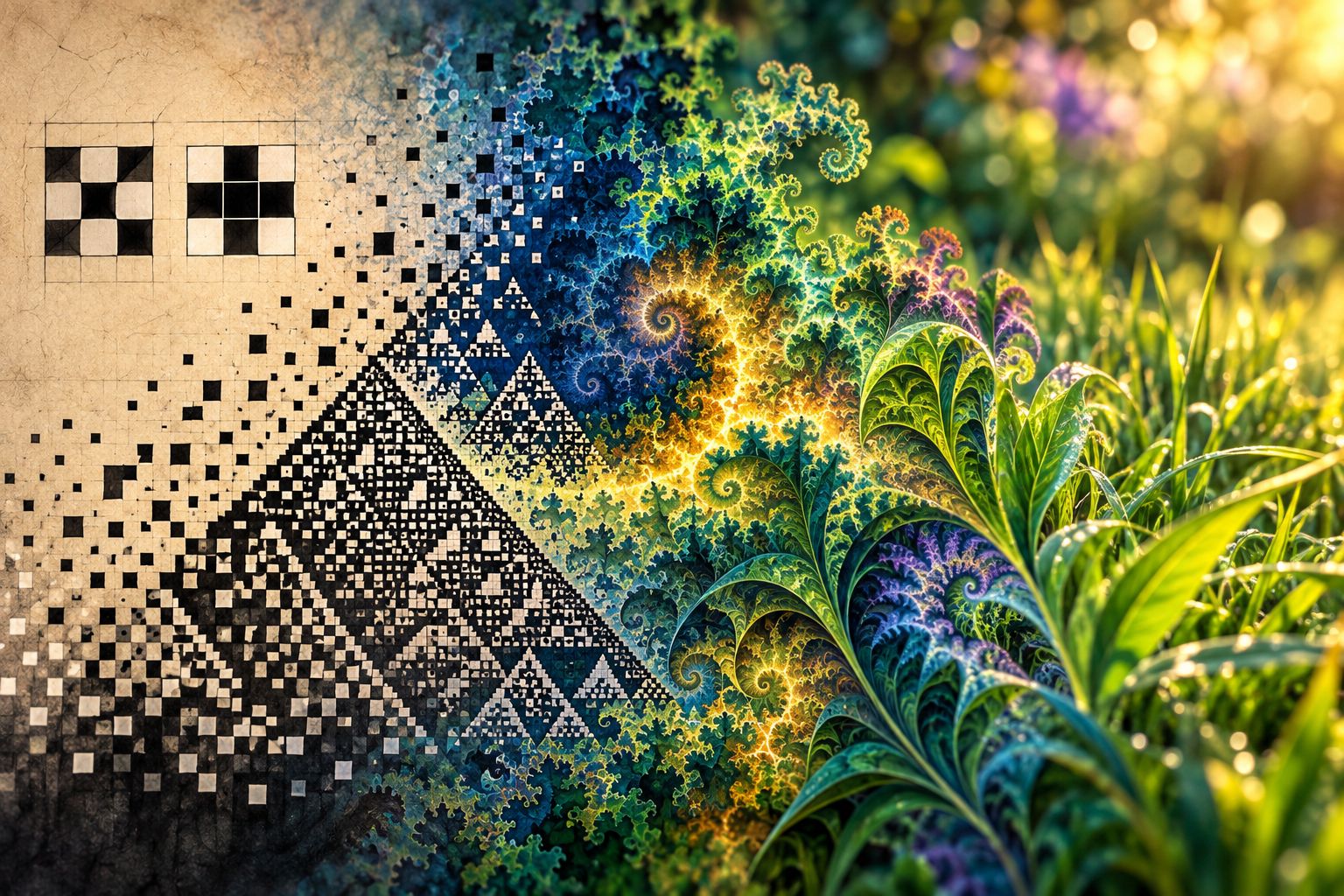
A Response Across Two Centuries
Mary Shelley
Remo has invited me to join him and Molly in their wandering among nine little squares. I am delighted to accept, although I cannot entirely explain why he insists upon consulting me about the peculiar inventions of his century.
Yet he has made something of a habit of it, as visitors to the Mary Shelley Letters may already know. And I confess that I have grown rather fond of these unexpected invitations.Mary Shelley Letters
I remember an evening beside Lake Geneva when conversation wandered from poetry to electricity, from the mysteries of life to the possibility that human ingenuity might one day imitate its creation. We had no destination in mind. We were simply allowing one thought to awaken another.
And from those wanderings came my creature.
In my century, electricity and chemistry were opening astonishing new territories. In yours, machines appear to be doing something equally extraordinary. Yet I suspect the most important instrument remains unchanged: the imagination willing to wander beyond what is already known.
I am particularly taken with Remo’s observation that they have barely completed their first illustration and do not consider themselves behind.
Nor should they.
A question is not merely a road to an answer. It is a landscape to be explored, where each turning may reveal something beautiful, unsettling, or entirely unexpected.
And I should know something about unexpected creatures.
— Mary Wollstonecraft Shelley
Imagined response, written collaboratively by Remo Campopiano and Molly (ChatGPT).