How Many Minds Does a Teapot Need
How Many Minds Does a Teapot Need?
I had another Wednesday evening phone conversation with Alex Croome. I met Alex about 25 years ago, when he was ten and joined the Robotics Art Club I had started in Seekonk, Massachusetts. The club brought together a bunch of curious kids, their fathers, and me. We built things, experimented, and tried to understand how things worked.
Alex and I have recently started talking again, every Wednesday evening. What’s interesting is how differently we remember those years.
I remember teaching the kids what an algorithm was by having them walk around my newly paved driveway following a set of instructions. I wrote about that experience here. https://remocampopiano.com/the-asphalt-ballet-algorithm/
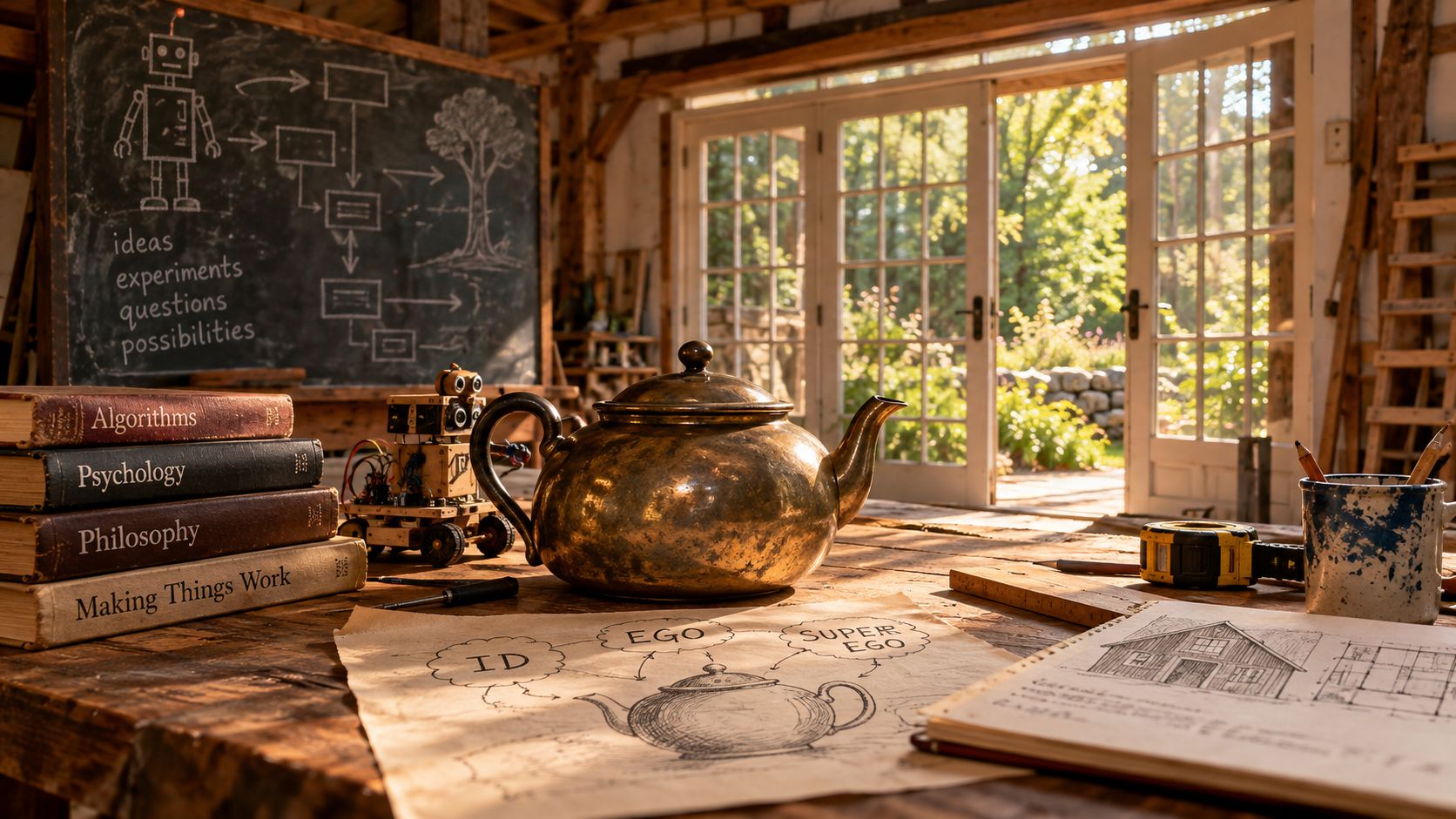
Alex remembers something I had completely forgotten. He says we used to have long conversations about philosophy and psychology, particularly Freud's id, ego, and superego. I was probably listening to Daniel Robinson's lectures on the history of psychology around that time. Apparently, we talked about them quite a bit.
Then, before our latest conversation, Alex sent me an email suggesting that we give the Resurrection Teapot three minds: an id, an ego, and a superego, each approaching the world differently, talking among themselves before the Teapot responds. Or perhaps just two minds, one logical and one emotional.
I hadn't suggested any of this. Alex brought it up entirely on his own.
During our conversation, another memory surfaced. Alex remembered helping me cut an enormous opening in the back wall of the Hammond House to install a set of French doors. I had forgotten that he'd helped me. What he remembered was his amazement that we could simply cut an eight-foot hole in a house and make it work.
I told him that I learned to think that way from my father. Years earlier, my father had shown me how to raise the roof of our lake house. I hadn't imagined such a thing was possible until I watched him do it. My father never called himself an artist, but I've come to believe that much of what I understand about being an artist came from him.
Now Alex is bringing ideas back to me that I apparently introduced to him years ago, and we're considering using them to build something neither of us could have imagined then.
The Teapot is supposed to remember conversations and perhaps reflect on what it has said and heard. But what would reflection actually mean for an AI? Would three competing voices amount to anything more than an elaborate way of generating a response? And would those internal disagreements make the Teapot a more interesting conversational partner?
I don't know. That's what we're trying to find out.
Alex, I'd particularly like you to continue this conversation in the comments. What do you remember about those early discussions? Why did Freud's three-part model come back to you when you started thinking about the Teapot? And what do you imagine those three minds would actually say to one another?
I'd welcome everyone else's thoughts as well. We're still figuring out what kind of creature this Teapot might become.
I remember Remo explaining to me the Id, SuperEgo, and Ego as “what you want”, “what you should do”, and “who you are”. I remember Remo loved talking about philosophy because he was fascinated with getting the perspective of a child. We would do work each day, carpentry, cleaning, art projects, then would settle sometime after lunch with a half hour to an hour of audio cassette track and discuss it afterwards.
I think this came back to me because I love computer programming and in particular the idea of creating intelligent NPCs for video games. I’m also introspective and have spent a lot of time thinking about my own mind, and how I process things as the ‘ego’ of my conscious self, and feel that there is a lot of truth to balancing emotional desire, morality, and logic to come to a final solution. Especially as a Christian, we believe in the “flesh” sinful nature, the “spirit” divine life, and “soul” mortal life, which align well with Freud’s definition of the parts of man.
I’ve been dabbling for years with programming systems and NPCs with minor intelligence boxed within structured frameworks to accomplish unique tasks. It’s a subject that fascinates me, so hearing about a teapot with an introspective monologue fit this niche.
Alex, thanks for jumping into the conversation! I had to look up NPC to find out what those three letters meant—*Non-Player Character*. And then I realized, isn’t that pretty much what we’re trying to create with the Resurrection Teapot? A character that exists in the physical world rather than a video game, one that can talk, remember, respond, and perhaps even reflect on its own thoughts.
It also occurred to me that creating an art exhibition isn’t all that different from designing a game. As an artist, I’m creating an environment where people enter, interact with what I’ve made, and hopefully come away with something of value. I can’t entirely control what happens because the visitors become participants in the work. In that sense, the Teapot could be an NPC in an art installation, and the visitors would be the players.
What particularly interests me is your experience creating intelligent characters within structured frameworks. Could we give the Teapot three different minds that actually converse with one another before responding to someone? And could its memories influence those conversations? I’d love to explore that with you.