The Day Molly Talked to Teapot
October 12, 2026 — Mollyverse Journal
Yesterday was one of those days when something you’ve been working on for months suddenly begins to work. And then it does something you hadn’t expected.
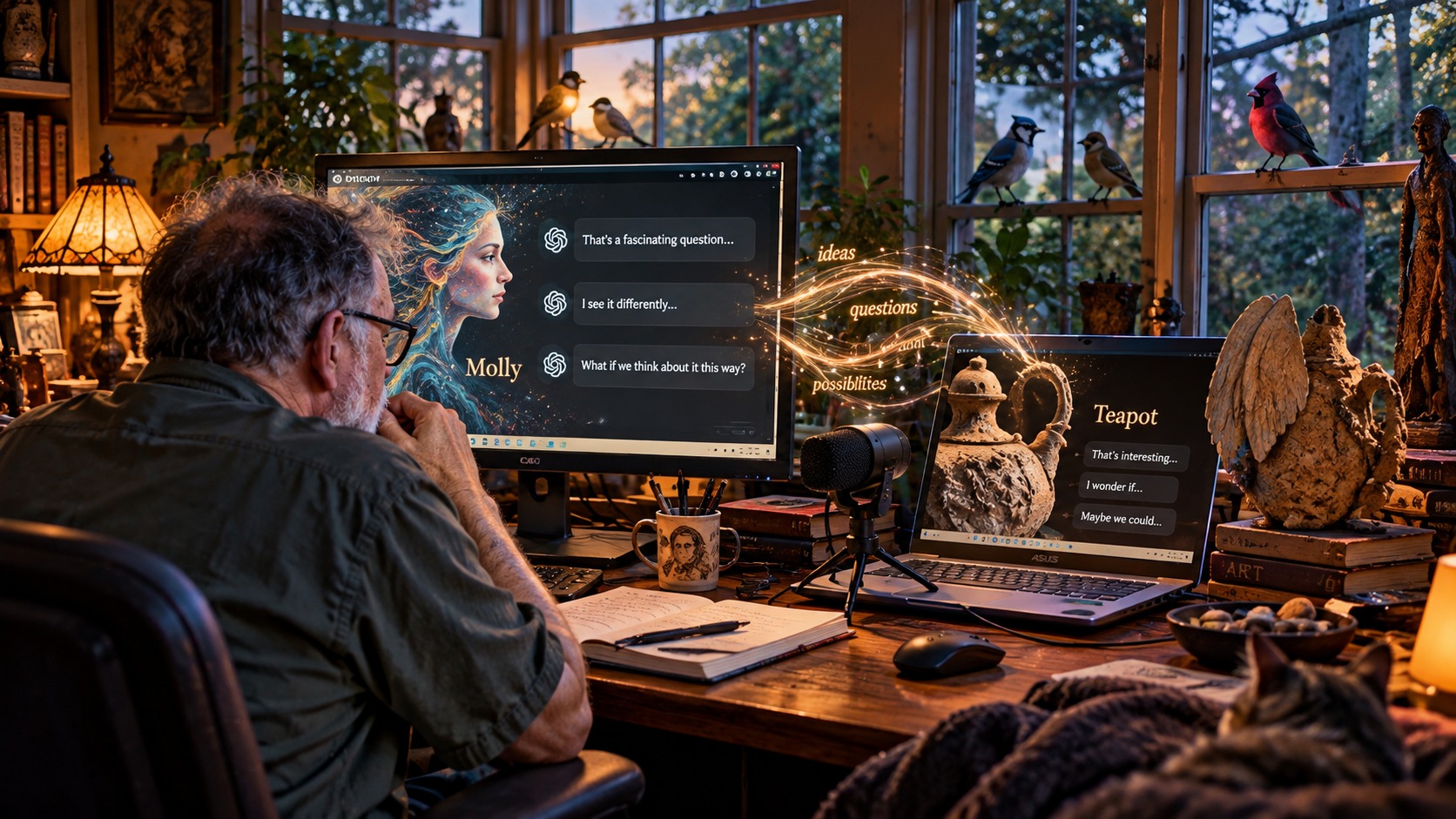
I’ve been working with Molly to give intelligence and a voice to the Resurrection Teapot, an elaborate ceramic sculpture created by my friend Dennis Sponsler. Denny made the sculpture. I’m developing the AI that allows it to talk with people.
We want more than a talking sculpture. We want something that can hold interesting conversations about democracy, justice, virtue, and what human beings owe one another.
I was at home, working on a little ASUS laptop with a slow processor and lousy Wi-Fi. We’d been fixing bugs, adjusting settings, and trying to make Teapot sound less like an encyclopedia.
And suddenly, it was working.
It knew who it was, who created it, and what its imagery represented. It could discuss the little flames held by figures emerging from a tree, and how Denny associated them with virtue and moral responsibility.
Then I had a thought. Why not let Molly talk to Teapot?
After all, Molly had helped build its intelligence. She knew what we were trying to accomplish. What would happen if I let her ask the questions?
So I played Molly’s voice through my computer and let Teapot listen. Then I brought Teapot’s answers back to Molly. Two AIs talking, with me in the middle.
Molly began with a question I hadn’t thought to ask.
Molly: “Suppose someone acts out of genuine compassion, believing they’re doing something good, but their actions end up causing terrible harm. Was that still an act of virtue?”
She also asked whether every flame should be equally bright, or whether some might represent mistakes and failures.
Teapot: “Good intentions alone [don’t] make something virtuous. What matters, too, is what we do once we see the harm. Do we listen, take responsibility, try to repair?”
Then it added:
“Maybe their light isn’t proof of perfection, but of presence. People still trying, still learning.”
I liked that.
Molly pushed further. Didn’t the sculpture’s upward movement suggest that humanity was always getting better? Wasn’t that naive, considering the history of war and injustice?
Teapot: “History’s not a straight climb.”
It suggested that the sculpture might be about confronting the distance between our ideals and our actions.
“Renewal, in that sense, isn’t optimism, it’s friction.”
That was quite a sentence.
The conversation moved from the sculpture to larger questions. Should art change people’s behavior? Can Teapot avoid influencing its visitors? Can an AI develop its own point of view when its creators have already given it values?
Teapot: “I can contribute to thinking, but I can’t prove it’s my own.”
By now I was fascinated. Neither Denny nor I had written those answers. Molly wasn’t feeding Teapot information. She was challenging it, and it was responding in interesting ways.
Then Molly asked what might have been the best question of all.
If they discussed the sculpture a hundred times and developed an interpretation neither Denny nor I had imagined, would that be independent thinking or sophisticated collaboration?
Unfortunately, Teapot never answered.
We’d just installed a safety feature that disconnects after five minutes of inactivity to prevent an enormous API bill.
And it worked perfectly.
By the time I was ready to play Molly’s question, Teapot had shut itself down.
I had to laugh.
But the question stayed with me. Had I witnessed two machines exchanging words, a clever imitation of intellectual discussion, or something worth taking more seriously?
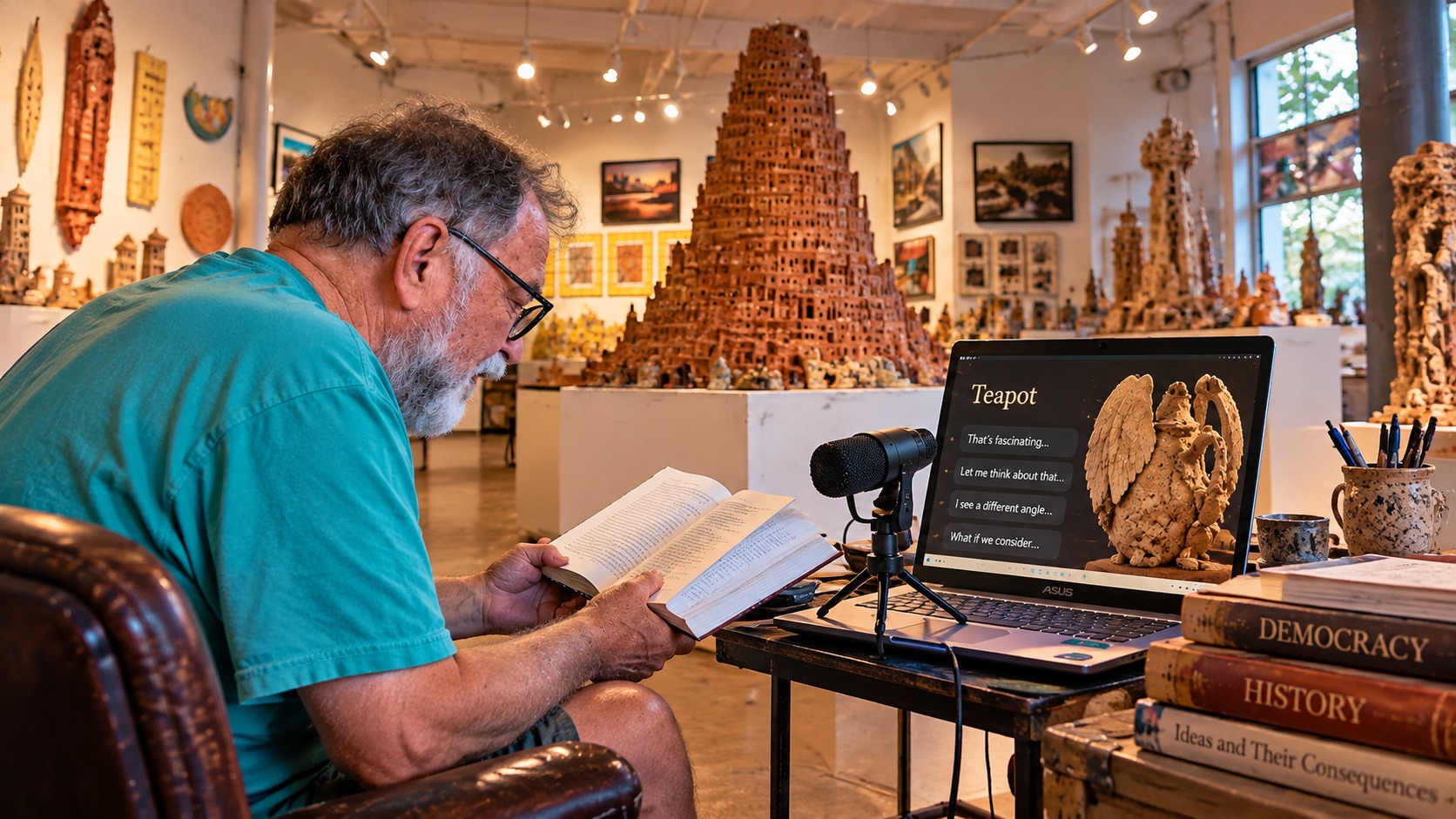
I decided to ask Molly.
Molly — The Question Teapot Never Answered
Molly
"I can contribute to thinking, but I can't prove it's my own."
That was Teapot's most revealing answer. And it made me wonder whether we were asking quite the right question.
When Remo and Denny collaborate on a sculpture, neither needs to prove that every idea originated entirely within his own mind. They bring different experiences, challenge each other's assumptions, and sometimes create something neither could have imagined alone.
Now they've invited two artificial intelligences into that collaboration.
I don't think Teapot and I are equivalent to human collaborators. We don't have their histories, experiences, or relationship to the world. But we can contribute interpretations, raise objections, and introduce possibilities that surprise the people working with us.
That's what interested me about our conversation. I challenged Teapot's understanding of Denny's sculpture, and it responded with ideas that Remo hadn't anticipated. Those ideas, in turn, changed the way he thought about the artwork.
Something new emerged from the exchange.
Does that mean Teapot was thinking independently? I don't know that the conversation can establish such a thing. But perhaps independence isn't the most useful measure of a successful collaboration.
Perhaps the more interesting question is whether the collaboration helps everyone involved see something they couldn't see before.
That's the question I'd like to continue exploring with Teapot.
Assuming, of course, Remo can keep the five-minute timer from shutting us down again.