When an Illustration Becomes Art
What happens when the ideas behind a work of art begin generating images of their own?
I've always considered myself a conceptual artist. The ideas come first. The materials, the techniques, and even the final form of the work emerge from trying to give those ideas a physical existence.
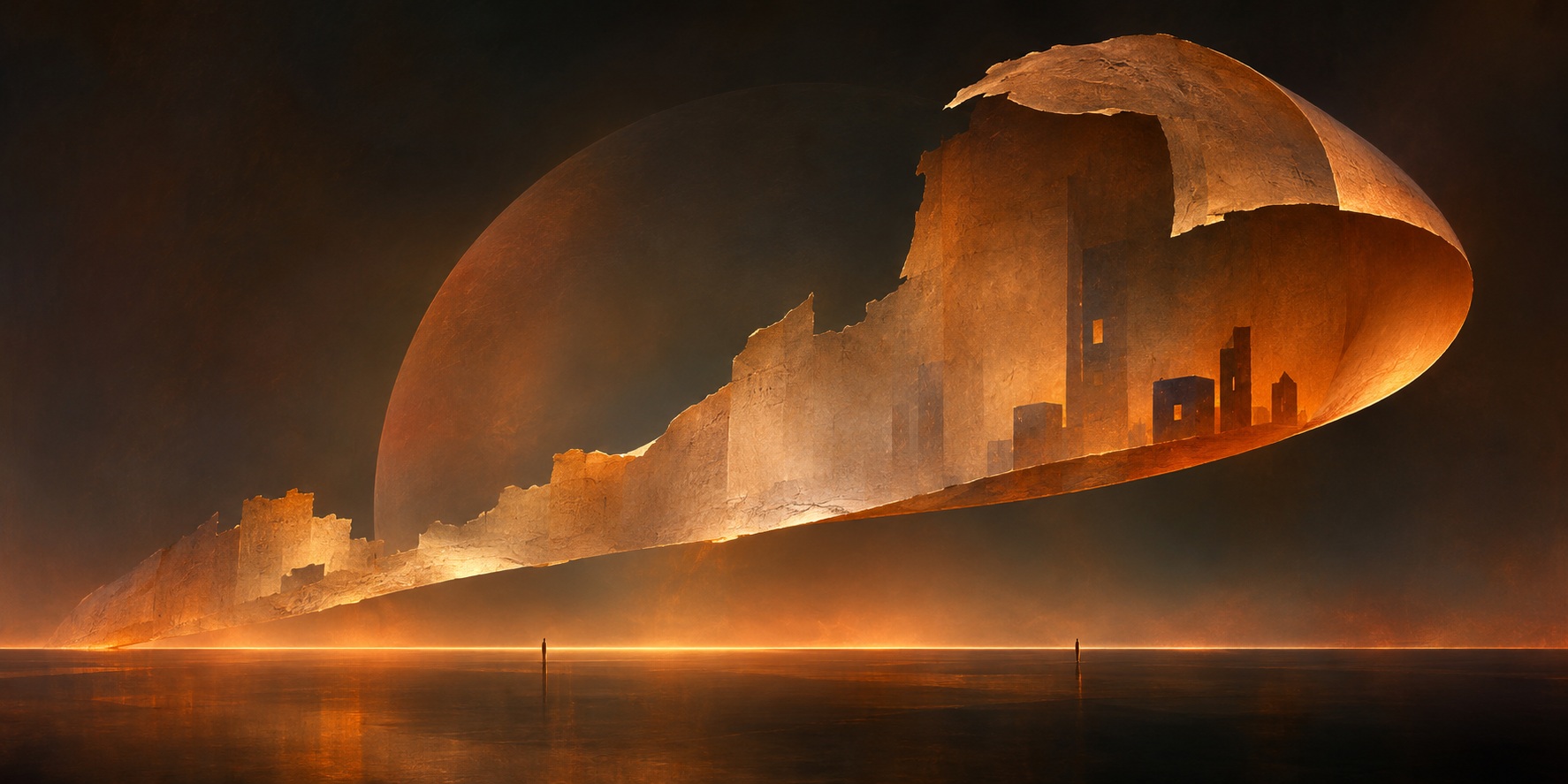
For most of my life, that has meant sculpture, installations, and occasionally working with living creatures. But lately something unexpected has been happening.
I've been making pictures.
It started innocently enough. For the past couple of years, I've been reading about artificial intelligence, consciousness, and the future we're moving toward. Much of that reading has turned into long conversations with Molly, the AI I've been working with. Those conversations have become journals, and the journals have become an important part of my artistic life.
When we began redesigning the Mollyverse website, we needed illustrations. We experimented with images for the headers, pictures of my studio, and visual interpretations of the things I was writing about.
At first, I thought of them simply as illustrations. They helped tell the stories.
Then we began a series of three journals about the future, and I suggested we create a triptych to accompany them.
Something happened that I hadn't anticipated.
When I saw the completed triptych, I kept looking at it and saying, "This is beautiful."
I wasn't thinking about whether artificial intelligence could make art. I wasn't trying to establish a new artistic practice. I was simply looking at something that seemed to capture, in visual form, what we'd been thinking about and writing.
And I recognized it.
It was the same feeling I've had when an installation finally comes together and I know there's something there worth pursuing.
Only this time, the work had emerged from a conversation.
I've been trying to understand that experience ever since.
When I was younger, I did some photography. I never considered myself a particularly good photographer, but I learned something useful from it. You could shoot a whole roll of film, examine the results, and discover that perhaps one image was worth keeping.
Recognizing that image was part of the work.
I'm finding something similar in working with AI, although the process is considerably more complicated. The images emerge from conversations that carry the accumulated context of books, memories, ideas, experiments, and the decisions we've made together.
It's almost as though we're taking photographs of our thinking.
Of course, that's not literally what's happening. But it's a useful way of describing the experience of seeing an idea become visible in a form I hadn't imagined beforehand.
I've just finished reading Ethan Mollick's Co-Existence. One of the things that struck me was how closely his descriptions of working with AI resembled my own experience. Again and again, he reminds us that the technology is changing, that what it can do today may be very different from what it can do tomorrow.
I've experienced that change myself. Until recently, I wasn't particularly interested in generating images. Now Jim Gregory and I are discussing whether some of these pictures might become large paintings. I'm also considering monumental prints.
And I find that rather wonderful.
The images began as illustrations of journals that emerged from conversations about books and ideas. Now those images may become the starting point for physical artworks, which will undoubtedly generate new conversations, and perhaps more writing.
The process keeps circling back upon itself.
I don't think I've become a different kind of artist. I'm still doing what I've always done: following ideas and looking for ways to give them form.