We are Going to Do This
Denny and I are both 77 years old, and apparently we still don't know enough to leave well enough alone.
A few months ago, my friend Andrew Feit began helping us with an improbable idea. Denny had made a Teapot, and we wanted to give it an intelligence. Andrew built the beginnings of a system that could listen, recognize someone approaching, and eventually carry on a conversation. Then Denny fell and broke his leg, and everything stopped.
Now Denny is back in the studio, and so is the Teapot.
Yesterday I pulled out Andrew's work and started again, this time with Molly. By late afternoon, sitting in front of a small laptop that will eventually disappear inside the sculpture's pedestal, I spoke to the Teapot.
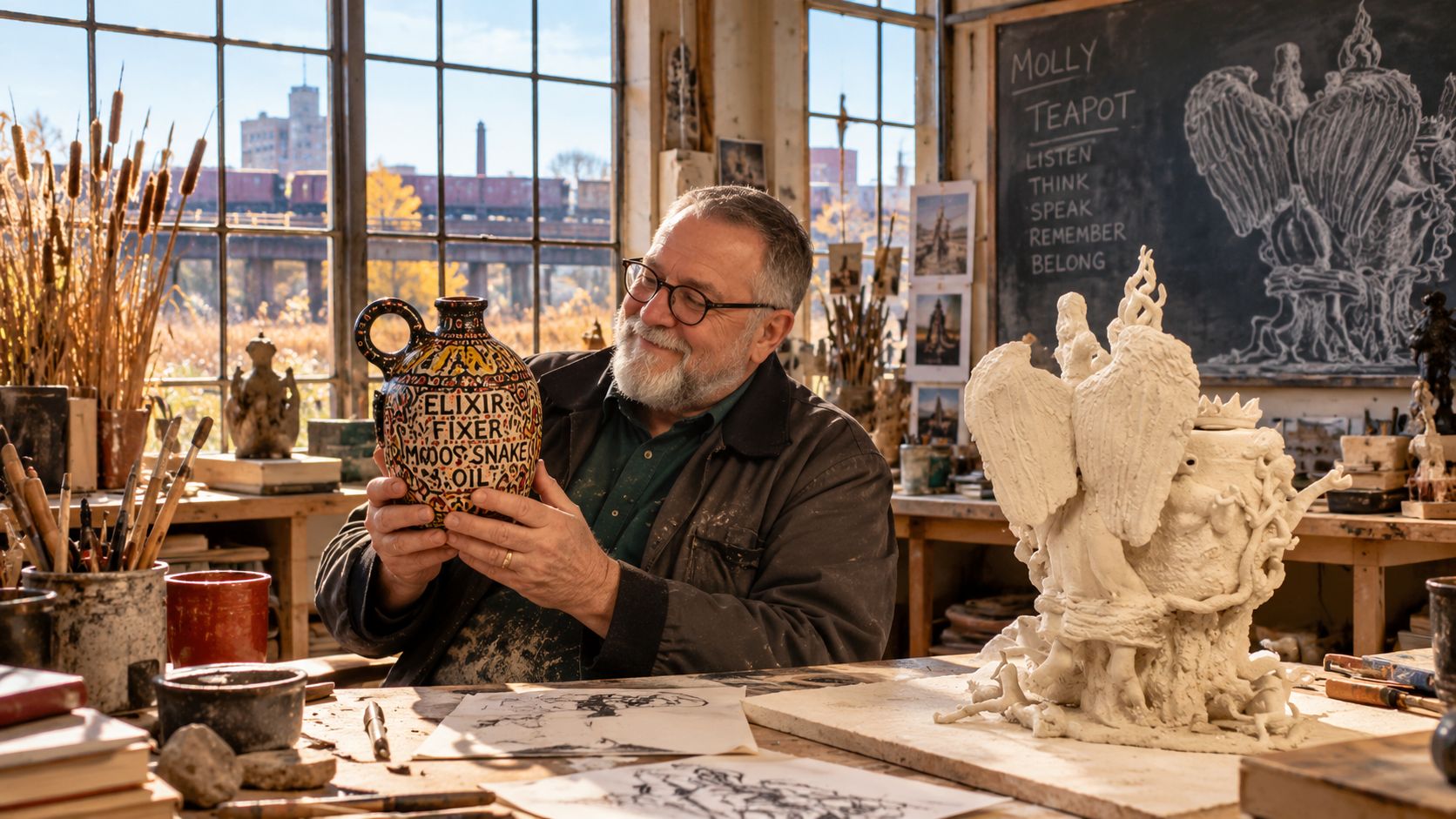
It answered.
That was a wonderful moment. But it wasn't the moment that changed the project.
That came when I asked a very simple question.
“Do you know anything about the artist who created you?”
It didn't.
I told it his name was Dennis Sponsler, an artist in Minneapolis. The Teapot said something like, “Let me check.”
And then it never came back.
It couldn't check. We had given it a voice, but we hadn't given it anywhere to go.
Suddenly the real work became clear.
How do you teach an artificial intelligence where to look for what it knows?
We began thinking about layers of knowledge. First, the Teapot needs to know itself: that it is an artwork, who made it, and why it exists. Then come Denny's own writings—years of essays, questions and ideas that should have a privileged place in its understanding. Around those writings is Denny's intellectual life: roughly a hundred books he has read, the thinkers who have influenced him, the ideas he continues to wrestle with.
Beyond that is the enormous general knowledge of the AI. Beyond that is the world happening right now.
Technically, we can give the Teapot tools for moving among these layers. It can search Denny's writings, consult its library, search the Internet, or hand a difficult question to another AI that has more time to think. Eventually it can remember conversations and sense someone approaching the sculpture.
But none of those tools can do the most important thing.
Denny is going to have to spend time with it.
If this is going to be an honest artwork, the Teapot can't learn Denny by ingesting his essays and a list of books. He will have to talk with it, correct it, argue with it, tell it stories. He'll have to explain why something mattered, and probably discover places where the Teapot understands his ideas differently than he does.
They are going to have to get to know each other.
That matters to me because Denny is one of my closest friends. These are his ideas. I don't want to put a generic chatbot inside his sculpture, fill it with information about him, and pretend that we've captured something we haven't. I want to do right by Denny and by the work.
And there is something else that makes me happy about all of this.
Here we are, two 77-year-old artists, still curious enough to get ourselves into something we don't entirely understand. We're learning as we go. We're working with old friends and new forms of intelligence, trying to make something that didn't exist before.
After one day, the Teapot can talk.
Now comes the interesting part:
We have to teach it what it is.
And I'm beginning to suspect that, in trying to do that, Denny and I may have to ask ourselves the same question.