Bare Bones
I’m not quite sure where to put this.
Is it a journal entry because it happened yesterday? Or is it part of my memoir because most of it happened more than thirty years ago?
Maybe it belongs in both.
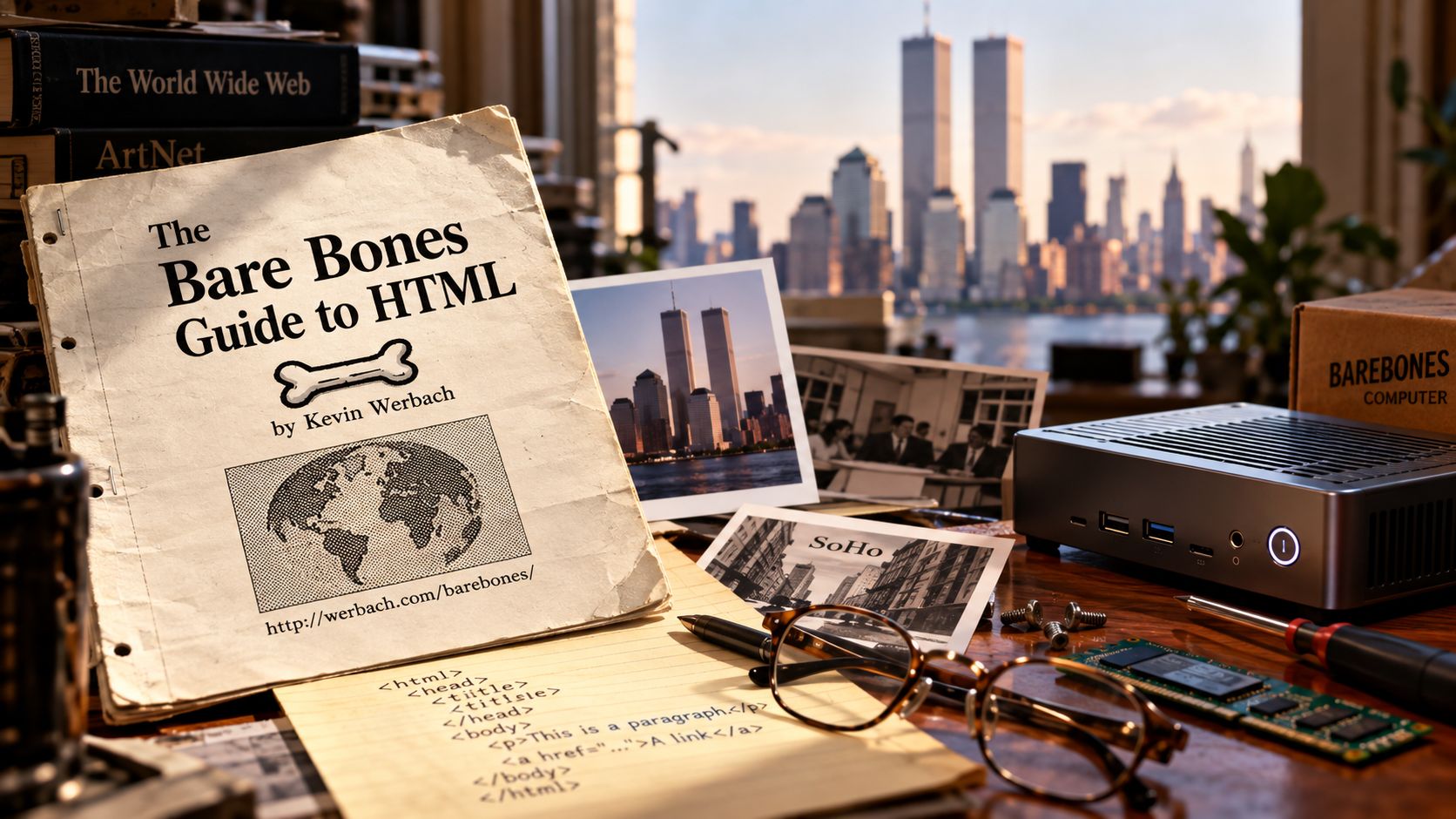
Molly and I were talking about buying a new computer. More accurately, we were trying to figure out how not to buy one.
I don’t need another screen. I don’t need another keyboard, mouse, camera, battery, trackpad, or sleek case with somebody’s logo on it. I already have all of that. What I need is the part inside that does the computing.
So Molly and I started wondering whether we could build one ourselves. Buy the essential pieces, probably from China, put them in a little box, and see how much computer we could get for a few hundred dollars.
Molly called it a barebones computer.
And suddenly I was somewhere else.
More than thirty years ago, in 1994, Jon Schull came to New York and introduced me to something called the World Wide Web.
I’ve written about that meeting in my memoirs here. We had lunch at the Crystal Court in the World Trade Center. I left desperate to find Rob and tell him what I had just seen.
We already had ArtNet running on the ResNova bulletin board system. What Jon showed me was something much bigger.
We had a tiger by the tail.
It turned out that the tiger came with an instruction manual.
And it was only a few pages long.
It was called The Bare Bones Guide to HTML.
I can still remember holding those pages and finding the whole thing almost preposterous.
This was what you needed to reach the world?
A few tags?
We never called it code. At least I didn’t. Code would have frightened people. Code belonged to programmers. These were just tags you put around words.
Put this tag here.
Put another one there.
This makes a paragraph.
This makes something bold.
This makes a link.
A link was the magical one.
A few characters typed into an ordinary text file could make a doorway to something sitting on another computer somewhere else in the world.
Today that sentence sounds almost embarrassingly ordinary.
Back then it was astonishing.
Rob and I had already experienced the power of connecting artists through ArtNet. GH Hovagimyan, Adrianne Wortzel, and others around us became enamored with this new territory too. We weren’t interested in computers because they were computers. We were artists looking at a place where almost nothing had been decided yet.
Nobody knew what a website was supposed to be.
Nobody knew what an artist was supposed to do there.
There were no social-media platforms waiting for us to fill in their boxes. No algorithms deciding who should see us. No templates making every page look like every other page.
There was barely a map.
It was wonderful.
From our little storefront in SoHo, I started teaching people how to make websites.
I would show them the Bare Bones Guide.
People had trouble believing me when I told them how simple it was. They would pay me to teach them, and I would essentially say: Look. You can do this.
Put some words in a text file.
Put these tags around them.
Send the file to a server.
Now look.
You’re on the World Wide Web.
The distance between I have no idea how to do this and I can reach the whole world was sometimes only a few sheets of paper.
I think that was what intoxicated us.
It wasn’t HTML.
It was possibility.
More than thirty years passed.
I forgot about the little guide.
Then Molly said bare bones.
I stopped her.
I knew those words.
So we went looking.
And there it was.
The Bare Bones Guide to HTML is still on the Web. The earliest public version we found dates from March 1995.
I looked at it and suddenly I could see that storefront again. I could see those sheets of paper. I could remember what it felt like to be surrounded by Rob and GH and Adrianne and other people who understood that we were standing at the edge of something, although none of us could possibly have understood how enormous it would become.
And here I am at 77, doing it again.
Molly and I have built the Mollyverse. We’re working on putting an intelligent voice into a teapot. And now we’re wondering whether, instead of buying my next computer, we might build the damn thing ourselves.
I like that.
Because underneath all these technologies, I think I’m still chasing the same thing I was chasing in that storefront.
Every once in a while, something that seems impossibly complicated opens up.
You look inside.
You discover that the machinery isn’t quite as mysterious as everyone has made it sound.
And suddenly you’re holding the bare bones in your hands.
That’s usually when things start getting interesting.
A Mollyverse bridge
This story began thirty-two years earlier, over lunch at the World Trade Center, when Jon Schull showed me something called the World Wide Web.