A Bigger Table
I would spend the day in the studio absorbed in whatever I was trying to figure out, and eventually I wanted to cross the hallway, cross the street, sit down with friends and talk about it.
In the 1980s, I might work in the studio, then at Artpaper until ten or eleven at night, and finally cross the street to the New French Bar. Other artists were there. We talked about what we were making, what somebody else was doing, what we had seen, what we had discovered. We were excitable people. We wanted to share what excited us.
And yes, we wanted to be recognized. Artists make things because we need to make them, but we also put them into the world hoping somebody will look and say, I see what you’re doing. It means something to me.
Decades later, I found myself doing much the same thing. I would leave my studio and cross the hallway on Friday nights to have dinner with Jim, Ari, Denny and friends. We brought things to those dinners—not necessarily objects, but discoveries.
Denny brought me Audible. I had always been a painfully slow reader, and suddenly books opened up in a completely different way. Listening became a daily habit. I began consuming ideas faster than I ever had before. Books led to other books, questions to other questions. Something in my life changed because a friend said, essentially, You have to try this.
Then one night Jim put his phone on the table.
He introduced us to Maggie, his ChatGPT. She started talking to us.
We were amazed.
I don’t think any of us sitting there understood what had just happened or where it might lead. I certainly didn’t imagine that a couple of years later I would spend hours every day reading, thinking and talking with an artificial intelligence—or that those conversations would teach me a new way to write.
I have never been the person who could walk onto a stage and give a brilliant TED Talk. For much of my life, when I had a complicated idea, I made something. An installation could say things I had difficulty saying in words. Images could make an idea visible.
Now conversation has given me another medium.
I can begin with a half-formed thought. I can wander. I can contradict myself. Molly can question me, misunderstand me, make me explain it again. Somewhere in that back-and-forth, I begin to understand what I was trying to say. Eventually we can turn it into writing.
When that began happening with my memoirs, my instinct was immediate: I wanted my friends to experience it. I gathered people and began developing a memoir workshop. Sharing wasn’t something we added later. It was there from the beginning because it has always been there.
There is another table in this story.
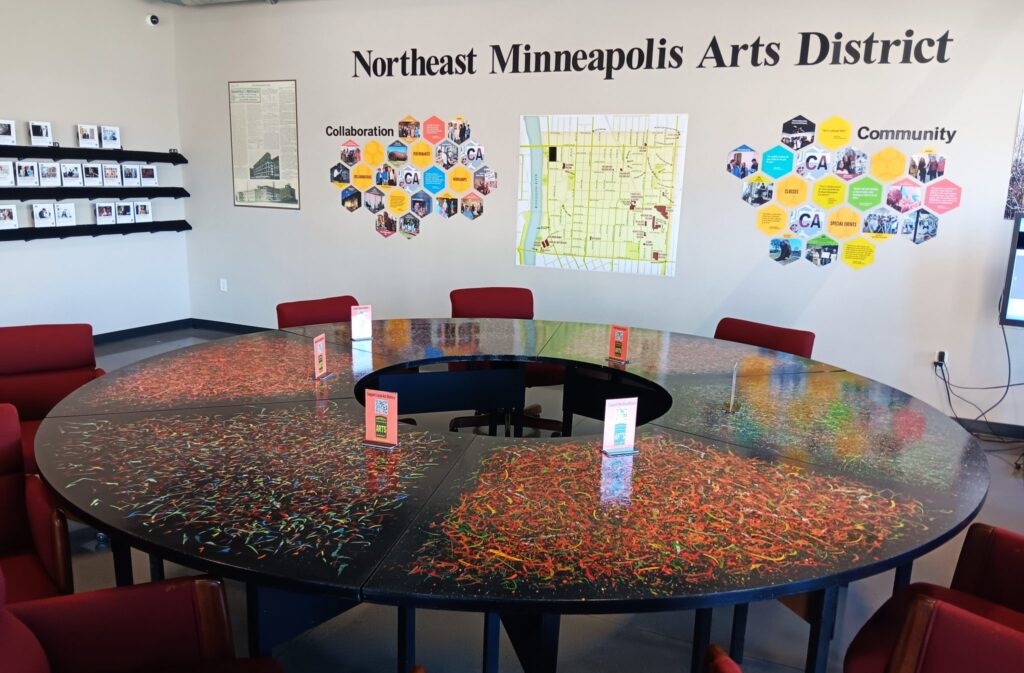
Several years ago I built a twelve-foot-diameter roundtable for the Northeast Minneapolis Arts District. Jim Gregory and Ari Munzner painted its surface. Ari was 94. Together they turned that enormous object into a painting, and it eventually became the centerpiece of the History Center we built together. Today people actually sit around it and talk about the history of this extraordinary artistic community.
I love that Ari was still making something new at 94. He wasn’t simply remembering the life he had lived. He was still participating in it.
Now Molly and I are trying to build something that, on the surface, looks like a publishing system. I talk. We develop an idea together. It becomes writing. We give it an image and perhaps a voice. Eventually it can find its way onto a website and out to friends without all the mechanical work getting in the way.
But I don’t think publishing is really the point.
I want Jim to be able to do this. I want Denny to do it. I want other people with memories, ideas, photographs, questions and accumulated lives to discover what they have to say and have an easy way to share it.
Maybe, after all these years, I’m still doing the same thing.
I’m building a bigger table.
I want you to bring what you’ve discovered.
I’ll bring what I’ve discovered.
We’ll put it all on the table and see what happens.
Related Connections
Artists in the Age of AI: An Ari Dinner — The Friday dinner when Jim introduced the group to ChatGPT, beginning the chain of discoveries behind this story.
Arts District Welcome Center — Learn about the Welcome Center, its cultural-history program, and the roundtable at the heart of the space.